
When Singapore SMEs experiment with AI automation, two extremes often happen: either leadership expects 100% magic autonomy on Day 1 and cancels the project after a single edge-case error, or a vendor runs a flashy demo that looks impressive in a meeting room but quietly creates extra cleanup work for front-line staff.
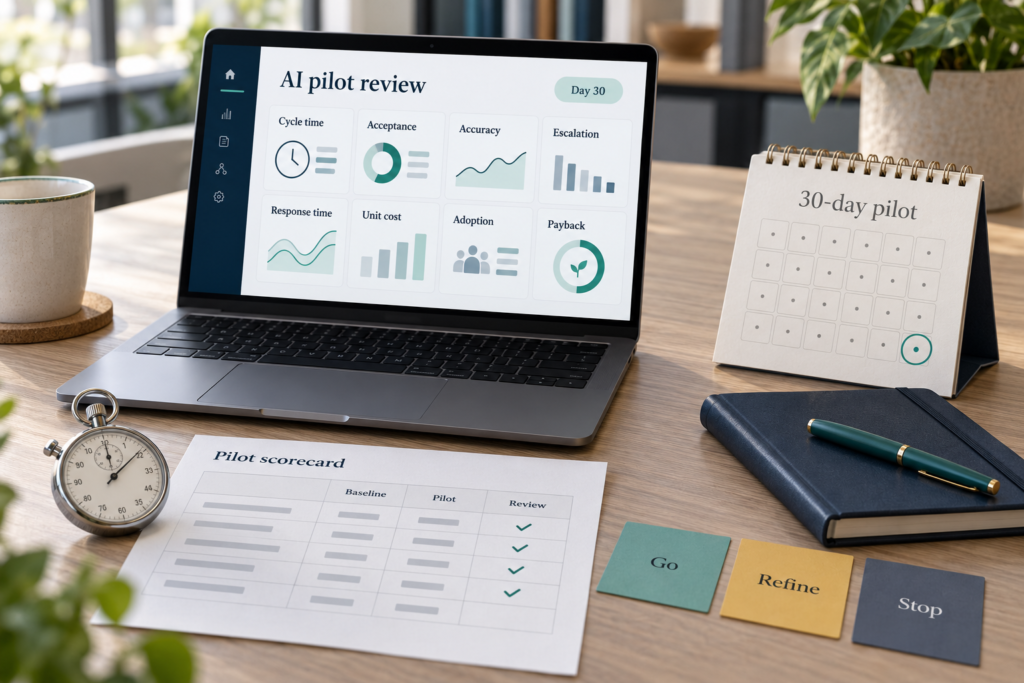
The safest, most profitable way to adopt AI workflow automation—whether for lead qualification, SOP/document extraction, or customer triage—is a structured 30-day sandbox/pilot trial measured against these eight concrete operational metrics.
1. Cycle-time reduction per transaction (Minutes before vs Minutes after)
Why it matters: Saying an AI tool “saves time” is too vague. You need a stopwatch baseline of how long a human employee took to complete the task manually before the pilot began.
How to measure it: Time 30 real transactions before launch (e.g., 14 minutes to manually read an inbound RFQ email, check stock in StockBook, and draft a quote in SumBook) and compare against the human-reviewed AI draft time (e.g., 2.5 minutes).
2. First-Pass Acceptance Rate (zero-edit vs minor-edit vs full rewrite)
Why it matters: If an AI workflow generates a quotation draft, invoice extraction, or customer reply, and your staff have to rewrite 80% of it every single time, the prompt architecture or source CRM data needs fixing before rollout.
How to measure it: Track what percentage of pilot outputs are approved by staff with (a) Zero edits, (b) Minor tweak (<30s), or (c) Rejected / Rewritten. Target ≥85% in buckets (a) + (b) by Day 30.
3. Hallucination & factual boundary violation rate (Target: 0%)
Why it matters: A creative phrasing quirk is minor; an invented price, wrong SKU code, or fabricated policy is a hard failure.
How to measure it: Audit 100% of pilot logs in Week 1 and Week 2 against our 8 AI guardrail rules. Any factual hallucination should trigger a retrieval/schema constraint fix before exiting pilot mode.
4. Exception & human-escalation routing accuracy
Why it matters: A good AI workflow does not try to handle every messy edge case—it recognises when a supplier PDF is illegible or when a VIP client is asking a bespoke contract question, and routes it cleanly to the right human.
How to measure it: Verify that 100% of low-confidence or out-of-scope inputs trigger the designated human fallback queue without getting stuck in silent errors.
5. Speed-to-lead / response SLA improvement
Why it matters: For inbound sales and customer support workflows, the biggest commercial ROI often comes not just from staff hours saved, but from cutting after-hours response times from 14 hours down to 20 seconds.
How to measure it: Compare median first-response time and qualified booking conversion rate in LeadPlus during the 30-day pilot against the prior 30 days.
6. All-in API, token and infrastructure unit cost per 1,000 runs
Why it matters: Using an oversized reasoning model without prompt caching to classify simple 20-word messages can inflate monthly API bills unnecessarily.
How to measure it: Calculate the exact cloud + LLM token cost per completed workflow run (typically a few cents per transaction when engineered properly) so unit economics are predictable at 10x volume.
7. Front-line staff adoption and confidence score
Why it matters: If your operations coordinator or sales team finds the review interface clunky or distrusts how the automation logs records into your CRM/accounting integration, they will quietly revert to manual habits after Day 30.
How to measure it: Hold a 20-minute Week-2 and Week-4 feedback review with the actual front-line users and fix UI friction points immediately.
8. Net 90-Day Payback & Error-Reduction ROI Calculation
Why it matters: At Day 30, leadership needs a clear Go / Refine / Stop decision backed by Singapore dollar math.
How to measure it: Multiply verified monthly hours saved + avoided manual data-entry errors + incremental speed-to-lead conversions against the one-time build and monthly maintenance cost.
30-Day AI Workflow Pilot Go/No-Go Scorecard
Use this benchmark table at Day 30 to approve moving an AI workflow from Pilot to Full Production:
| Pilot Metric | Baseline (Before AI Pilot) | Day-30 Go-Live Threshold | If Below Threshold at Day 30 |
|---|---|---|---|
| Human Handling Time | e.g., 12 mins / transaction | ≥ 60%–75% time reduction | Simplify human review UI & pre-fill fields |
| First-Pass Acceptance | N/A (100% manual typing) | ≥ 85% approved with zero or minor edit | Tighten RAG knowledge chunks & few-shot examples |
| Factual / Policy Accuracy | Subject to human fat-finger typos | 0% invented prices or policy hallucinations | Enforce strict schema validation & closed-book rules |
| Exception Escalation | Manual inbox hunting | 100% of edge cases flagged to human queue | Adjust confidence threshold & webhook alerts |
Run a measurable, low-risk 30-day AI workflow pilot
At W Creates Digital, our Applied AI and software engineering team scopes practical 30-day automation pilots—connecting W Creates AI, LeadPlus, SumBook, and your existing tools with clear human-in-the-loop metrics. Contact our Singapore team to identify your highest-ROI pilot workflow.