
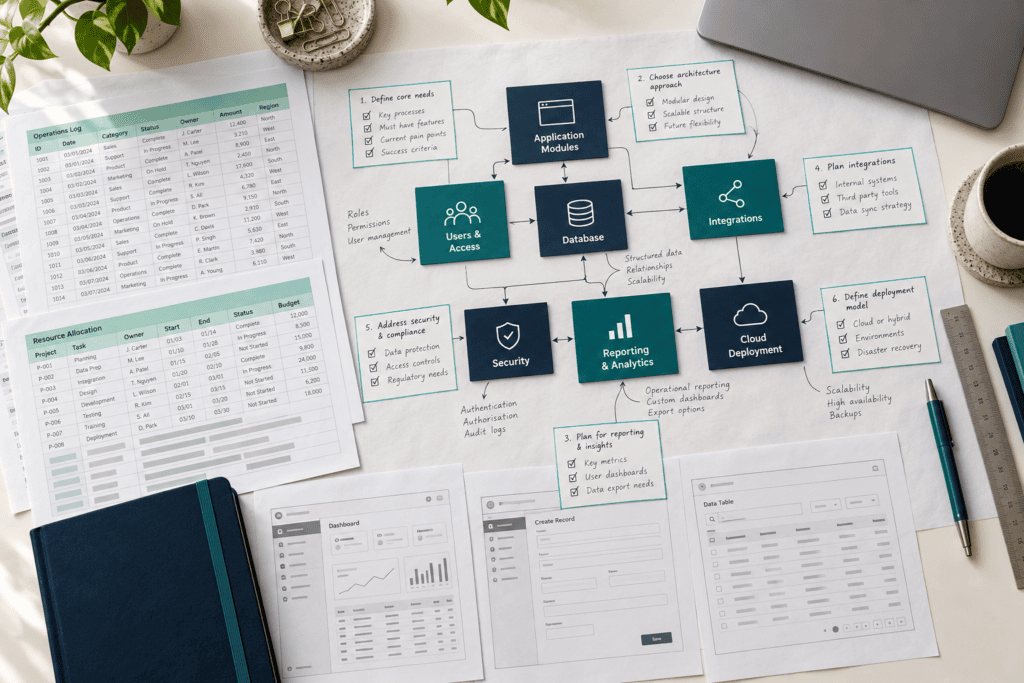
As Singapore businesses grow past initial operational scale, managing inventory, billing, and customer relationships through decentralized spreadsheets becomes a severe operational bottleneck and data vulnerability.
1. Relational Schema Normalization Over Tab-Based Proliferation
Spreadsheet tabs blur the boundaries between entities. Transitioning to a relational database (PostgreSQL, MariaDB) enforces strict data types, foreign key constraints, and relational integrity.
2. Role-Based Access Control (RBAC) and Audit Logging
In spreadsheets, anyone with access can overwrite financial formulas. Custom web applications enforce granular Role-Based Access Controls (RBAC), ensuring staff only access authorized operational functions.
3. API-First Architecture for Multi-Platform Extensibility
Design modern modular architectures that separate back-end business logic from presentation layers via RESTful or GraphQL APIs, ensuring future mobile apps can seamlessly interface.
4. Automated Backup and Disaster Recovery Protocols
Moving corporate data to the cloud requires automated daily offsite snapshots, end-to-end data encryption, and point-in-time rollback protocols to guarantee business continuity.
Building Scalable Enterprise Software
Transitioning from fragile spreadsheets to enterprise cloud software protects institutional memory and unlocks operational scalability. To explore how W Creates Digital engineers custom business suites and cloud SaaS platforms like SumBook, PeopleBook, and StockBook, visit our What We Do page or consult our software engineering team via our Contact page.