
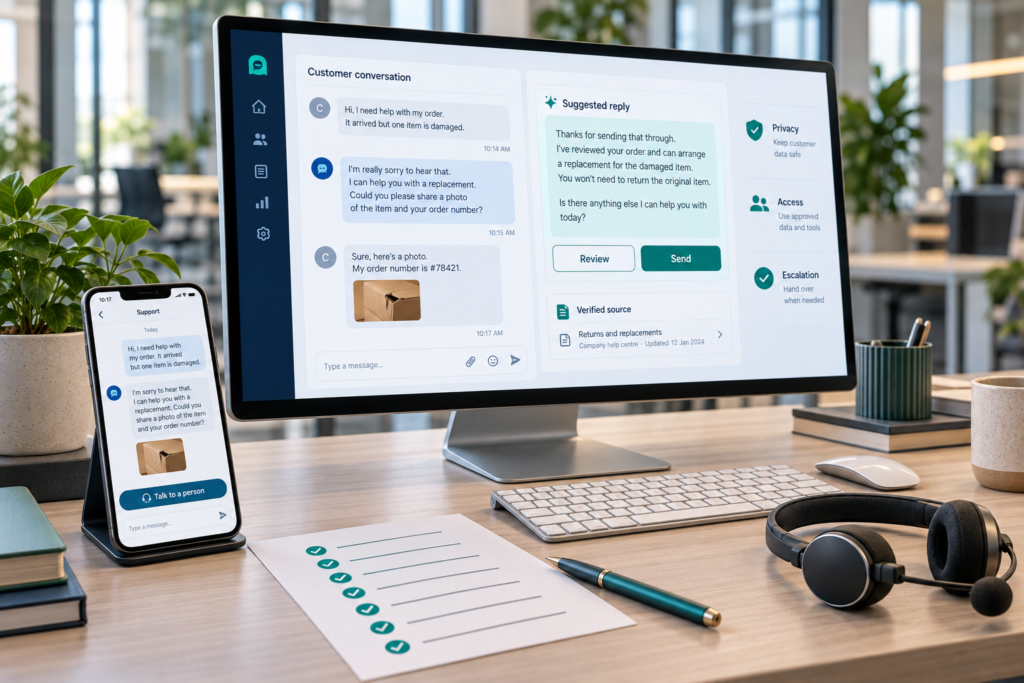
Deploying Large Language Model (LLM) customer service chatbots can dramatically reduce response latency. However, deploying an unconstrained AI assistant without strict operational guardrails exposes your business to hallucinations, pricing errors, and customer dissatisfaction.
1. Retrieval-Augmented Generation (RAG) Grounding
Never permit an AI bot to generate responses from generalized public web knowledge. Confine conversational responses strictly to a curated, verified internal knowledge base using Retrieval-Augmented Generation (RAG).
2. Deterministic Human-in-the-Loop Escalation Triggers
Establish automated sentiment and intent detection that immediately transfers complex complaints, refund requests, or frustrated users to a live human support executive.
3. Strict PII Redaction and Data Privacy Filters
In compliance with Singapore's Personal Data Protection Act (PDPA), implement automated masking of NRIC numbers, credit card details, and personal contact info before transmitting prompts to LLM endpoints.
4. Real-Time Confidence Scoring and Output Auditing
Deploy secondary evaluation models that audit AI conversational accuracy, hallucination rates, and customer sentiment scores in real-time.
Deploying Trustworthy Enterprise AI
Deploying AI automation with disciplined guardrails elevates customer satisfaction while mitigating operational risk. To explore how W Creates Digital engineers custom Generative AI copilots and automated lead frameworks through LeadPlus, visit our What We Do page or consult our AI team via our Contact page.